
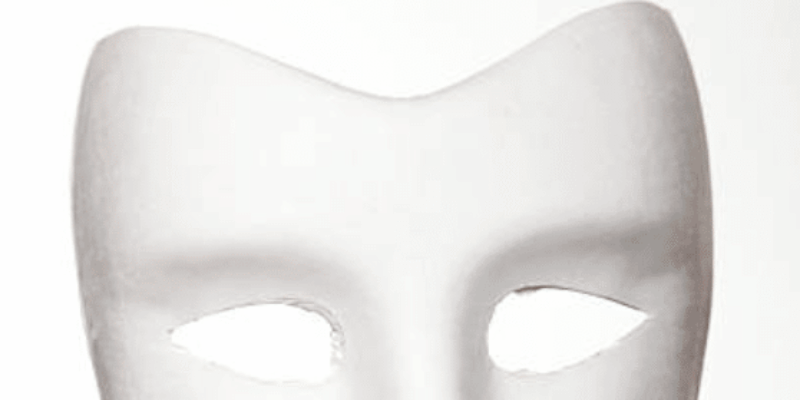
“A mask tells us more than a face.” – Oscar Wilde
Though our Central Texas weather hasn’t gotten the memo, it’s October. Spooky season. We’ve already got our costumes figured out (thanks to my wife who already has them ordered for the next Halloween before we even run out of candy), but that’s not new. We’re known as the costume house and our kids’ friends often ask to pick through our costume bins when it comes time to trick-or-treat.
It’s fun, just for an evening, to become someone else. To put on a mask and have people see you and call out who you are dressed to be. (This backfired on us one year when our family went as characters from Dora the Explorer – I was Click the Camera but most people thought I was a washing machine. It was worse for my wife: she was The Map but was mistaken as toilet paper.) Even with our masks on, we want to be known.
For many adoptees, wearing masks is not only for Halloween. It is part of their survival and felt safety at a subconscious level. Children – even while in the womb and in infancy – are learning who they are. For children whose existence is seen and celebrated, the question, “Who am I?” Is answered with “You are loved! You are wanted! You are a gift and a blessing!” And that identity is affirmed with every answer to their cry and every meeting of their needs. This is the foundation of attachment.
However, for children whose existence is riddled with trauma, loss, and/or separation, their question changes fundamentally from “Who am I?” to “Who do I need to be in order to get my needs met?” That is when the masks come out.
As I have looked over and understood my own story, I can see how this played out for me as an adoptee.
For my bio mother, who was herself scared and lonely in her pregnancy, I was a secret to be hidden not a son to be celebrated. By the time I was born and had spent a couple of months in foster care, I came to my adoptive family calm and quiet – a “perfect baby” who rarely cried. I have since learned that crying is a healthy thing for a baby who is using their God-given voice to express needs and get them met. From my earliest days, I learned that the best way to be loved, accepted, and not abandoned was to suppress any deep needs or negative feelings. I put on the mask of optimism and sacrifice, being whatever I needed to be to those from whom I needed anything while minimizing my own needs so as not to be a burden.
I am in my forties now, and I am still learning how to put down those masks. It is a gift to see that it is possible; there is hope for me and for my kids – two of whom are also adopted out of foster care.
What has helped me is knowing God – who identifies Himself as Father. My Father. In Psalm 139 I see that my story began BEFORE the rejection and abandonment I experienced: “For it was YOU who created my inward parts; YOU knit me together in my mother’s womb. I will praise you because I have been remarkably and wondrously made.” (Emphasis mine)
I am learning that the same Father who made me wants to hear my voice and meet my needs. He designed me with divine intentionality, and I am freed up to be the me He created – without masks.
As you think about your children – particularly those who came to you through adoption, regardless of their age – here are some things to be mindful of:
Your child thinks about their first family, even if they don’t say as much. I remember being a child and imagining what “the other me” was like. The other me was the version of me who wasn’t adopted but stayed with my family of origin. We do our best as parents to give our children opportunities to explore their own feelings and thought processes around their story and family of origin, and not simply rely on when they choose to ask questions.
It is important to honor their story, family, and cultural background. The story of every adoptee includes beauty and wounding, love and loss, sadness and joy. There are beautiful, God-imaging ways that your child reflects where they came from, and we want to call those things out! This goes from eye color to cultural cuisine. We can show our children that they are a beautiful combination of where they are and where they came from; their goodness is not tied to their ability to assimilate into our family dynamic.
You may know that your child is loved and belongs in your family, AND your child is picking up many subtle but impactful messages to the contrary. Though this may seem confined to trans-cultural or trans-racial adoptive families, it applies to all adoptees! I am white and was adopted into a white family, but I did not look like anyone in my adoptive family. I sensed in my heart an unspoken whisper that told me I did not truly belong, that I was other. This played directly into the idea that I needed to put on a mask to belong. When you add in comments from other people who are trying to make sense of your family – “Is that really your sister?” “Why don’t you look like your parents?” “Where are your REAL parents?” – it is easy to understand how an adopted child can feel confused about who they are.
As with all parenting – indeed, with all of life – Truth and grace are equally vital to navigating the complex challenges faced by our children from adoption. As parents, we are constantly pointing
out who our children truly are at their deepest level even as we are learning who they are ourselves. We are doing so with patience and understanding, knowing that the masks they picked up are part of how they survived, even as we show them that they don’t need the masks anymore. We show grace with curiosity rather than judgement, honoring their story and not taking it personally when they struggle to remove the mask.
With your help as a parent who loves them, sees them, and calls out who they are, your adopted child will pick up those masks less and less.
And one day, maybe only at Halloween.